
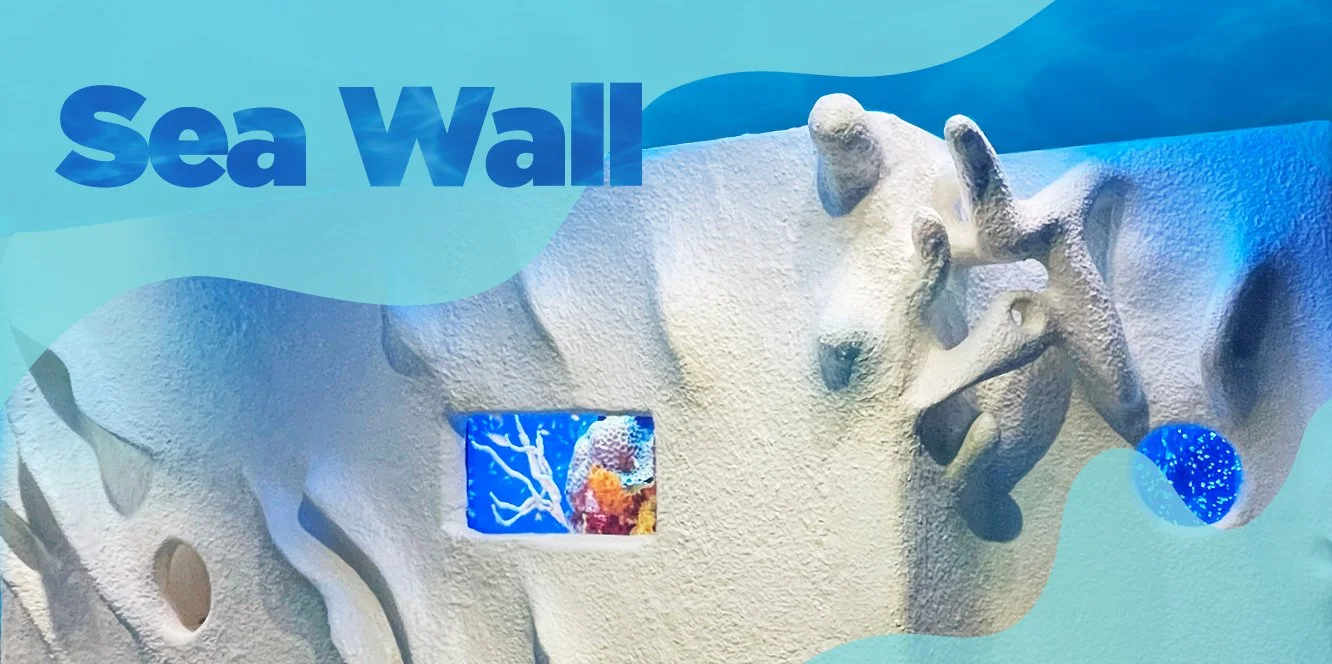
Sea Wall
Chicago Children’s Museum is proud to house the one-of-a-kind sculpture for children by world-renowned artist Richard Hunt: Sea Wall. Raised on Chicago's South Side, Richard Hunt graduated from the School of the Art Institute of Chicago and became one of the most influential African American abstract sculptors of the 20th century. His work is now represented in over 125 public museums around the world. Hunt also made the largest contribution to public sculpture in the United States with more than 160 public sculpture commissions.
Hunt was the first Black sculptor to have a solo show at the Museum of Modern Art in NY and the first Black visual artist to sit on the National Council on the Arts.
He was a teacher at Wendell Philips High School in Bronzeville and The School of the Art Institute of Chicago.
His work was influenced by his part in the Civil Rights Movement. His sculptures reflected the time in which he lived and his belief that all people should be treated fairly.
He lived to 88 and continued to make art in his workshop in Chicago until his last days.
Our Sea Wall installation will feature:
Hands-on activities, such as a “build your own diorama,” sand spinner, and a mystery box with aquatic animals
A miniature diorama of a water scene
Calming displays of bubbles and an aquarium in a nod to Sea Wall’s history
Alongside the reconstructed Sea Wall, the exhibit will feature a panel on Richard Hunt and his legacy, as well as a tactile experience using real artifacts from Richard's studio. Children will be able to see and touch tools Richard created by hand to serve his artistic vision, as well as explore the many ways he was inspired by the natural world. Tiles created by Chicago children inspired by Richard Hunt and Sea Wall will be showcased in the space.
Originally created for the children’s center lobby at the former Michael Reese Hospital in 1971, Sea Wall housed various aquaria for children to engage with while visiting the hospital. When the hospital was being renovated in the mid-2000s, a demolition contractor started cutting up Sea Wall to remove it. Oscar Edmond knew of Hunt’s work and, having recognized the piece, stopped them. He got permission from the hospital to salvage the piece. Edmond moved the parts to his home where he stored it until 2024 when he and his wife, Karen, began downsizing. During the process they realized the sculpture was commissioned by the Ruttenberg family and decided to reach out to them. The Ruttenbergs were given possession of the piece and in June 2024, the Ruttenberg family chose to bring the sculpture to CCM with the charge to restore and reimagine the piece as an interactive experience.